The State of AI Reliability
The AI status-page gap: only 16% of monitored AI services expose a verified status feed.
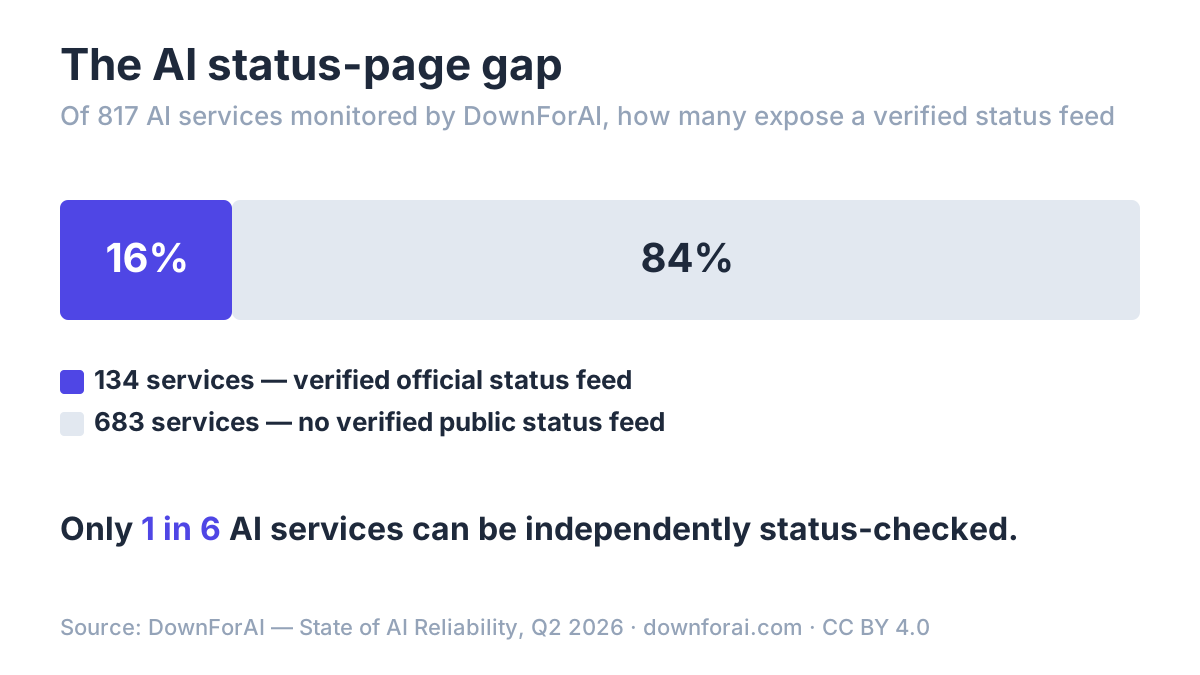
The practical consequence: for most AI services, when something breaks, teams cannot independently confirm whether the fault is theirs or their provider's — because the provider exposes no status feed to check against. This report and its dataset are free to cite and reuse under CC BY 4.0. Open data: downforai.com/ai-status-services.json.
Why this matters
Modern software runs on AI services it does not control. A single chatbot product might depend on an LLM API, a speech-to-text service, an image generator, and a vector database — four external dependencies, four potential points of failure, owned by four different companies.
When one of them degrades, the product breaks. And the first question every engineering team asks is the same: “Is it us, or is it them?”
Answering that requires one thing: a way to check the provider's status independently — something public, official, and machine-readable. A status feed. We wanted to know how often that basic accountability actually exists across the services we track. So we measured it.
The headline number: 16%
Across the 817 AI services monitored by DownForAI, only 134 expose a verified, machine-readable status feed — a public status endpoint (such as an Atlassian Statuspage JSON feed or a cloud-provider health API) that we can independently confirm and monitor. That is 16% of our monitored catalog.
The other 683 services (84%) expose no verified public status feed. Some may communicate incidents through other channels — a support page, a changelog, a social account — but none of these is an official, independently checkable status feed suitable for automated monitoring. We count proof, not promises: a marketing page claiming “99.9% uptime” does not qualify, and neither does a reachable homepage.
A note on scope: this is 16% of DownForAI's monitored catalog of 817 services — deliberately broad, and weighted toward the long tail of niche and emerging tools. It is not a random sample of “the AI industry,” and shouldn't be read as one.
The LLM blind spot
The most consequential finding is in the category everyone depends on.
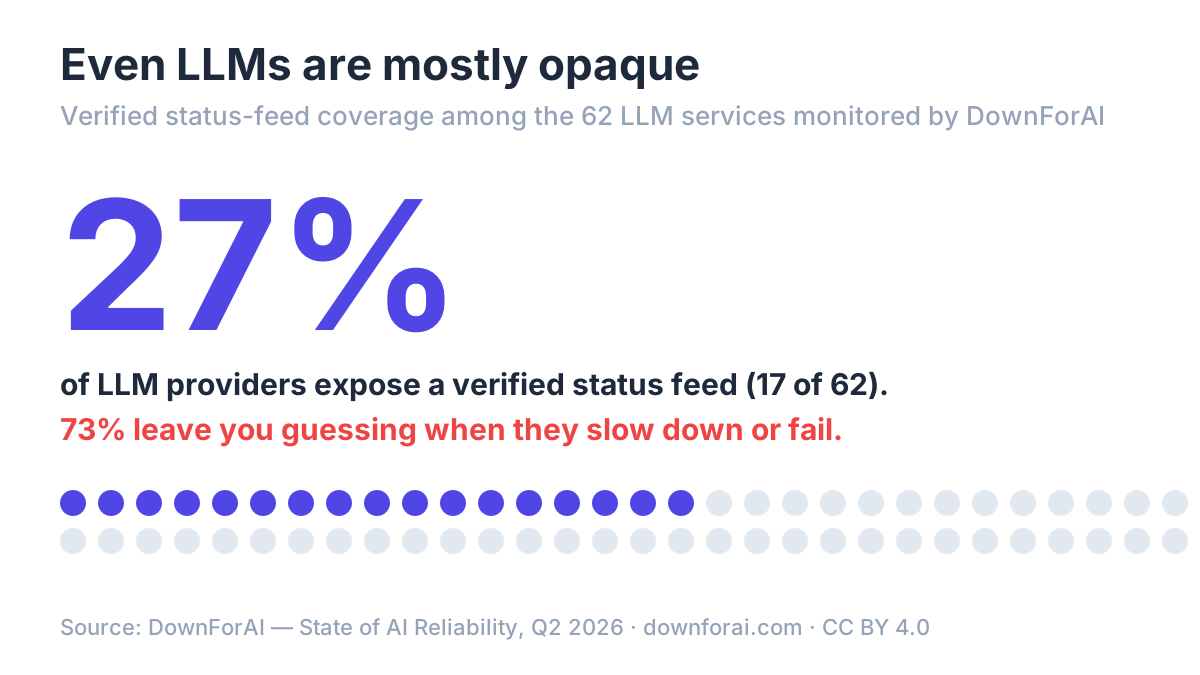
Large language models are the foundation of the 2026 AI boom — and only 27% of the ones we monitor expose a verified status feed. Of 62 LLM services, just 17 publish one. The other 45 offer no verified, machine-readable way to confirm whether they are operational.
The well-known frontier labs mostly do publish status feeds. Names like OpenAI, Anthropic, and Mistral expose clean, machine-readable status endpoints that anyone — including DownForAI — can monitor in real time. That is the model the rest of the category should follow.
The opacity concentrates in the long tail of LLM providers: smaller, regional, and specialized model APIs that quietly power a large share of production applications. They are precisely the services least likely to tell you when they're down — and the hardest to independently verify when they are.
Transparency tracks technical buyers
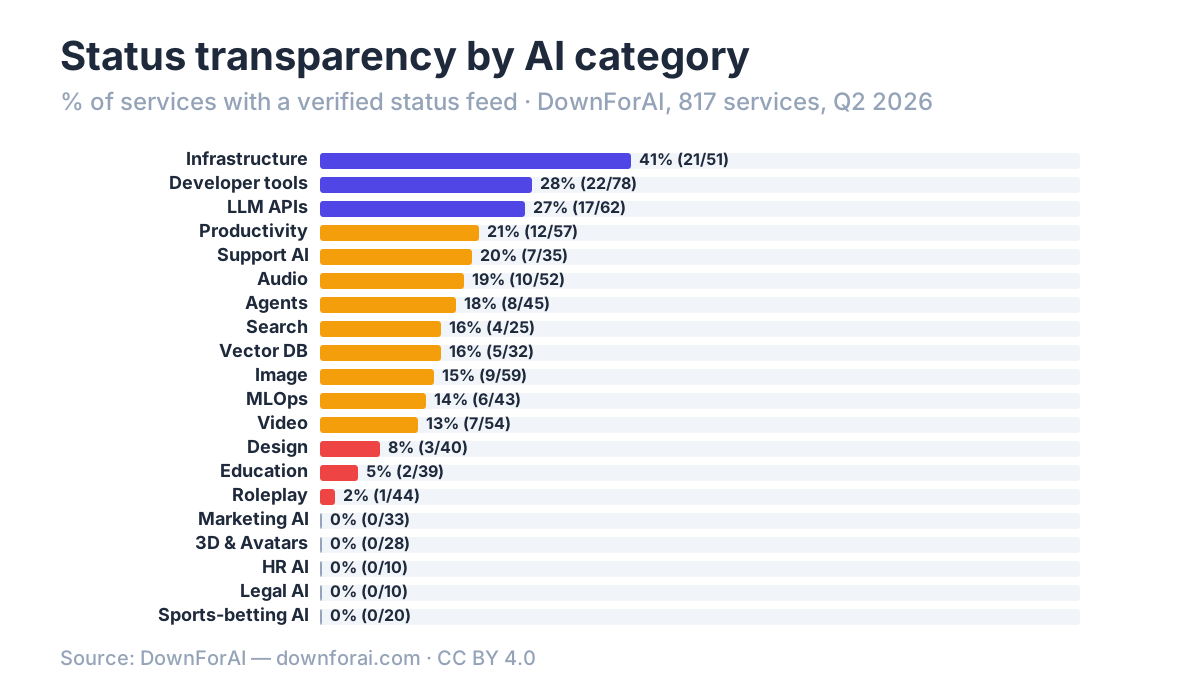
Breaking coverage down by category reveals a clear pattern.
| Category | Services | Verified | Coverage |
|---|---|---|---|
| Infrastructure | 51 | 21 | 41% |
| Developer tools | 78 | 22 | 28% |
| LLM APIs | 62 | 17 | 27% |
| Productivity | 57 | 12 | 21% |
| Support AI | 35 | 7 | 20% |
| Audio | 52 | 10 | 19% |
| Agents | 45 | 8 | 18% |
| Search | 25 | 4 | 16% |
| Vector DB | 32 | 5 | 16% |
| Image | 59 | 9 | 15% |
| MLOps | 43 | 6 | 14% |
| Video | 54 | 7 | 13% |
| Design | 40 | 3 | 8% |
| Education | 39 | 2 | 5% |
| Roleplay | 44 | 1 | 2% |
| Marketing AI | 33 | 0 | 0% |
| 3D & Avatars | 28 | 0 | 0% |
| HR AI | 10 | 0 | 0% |
| Legal AI | 10 | 0 | 0% |
| Sports-betting AI | 20 | 0 | 0% |
The pattern suggests status transparency is strongest in categories with technical buyers. Infrastructure (41%) and developer tools (28%) lead — their customers expect, and audit, operational transparency. An engineer evaluating a vector database or a CI tool looks for a status feed, and its absence is a red flag, so vendors provide one.
At the other end, five categories had no verified official status feed in our dataset: marketing AI, 3D & avatar tools, HR AI, legal AI, and sports-betting AI. These serve buyers who rarely ask “where's your status feed?” — so it doesn't get built. (Two of these categories contain only 10 services each, so read the 0% as “none detected in a small sample,” not a sweeping claim.)
What the transparency gap means in practice
Misattributed failures. When a product breaks and its AI dependency exposes no status feed, blame lands on the wrong party. Support teams burn hours and engineers chase bugs that aren't theirs — because the provider gave no way to rule itself out.
Less public accountability. A provider with no public status surface leaves no public record of its outages. Transparency creates pressure to improve; its absence quietly removes it.
The verification gap falls on third parties. Where official status feeds don't exist, the only remaining signals are independent monitoring and community reports. That's the 84% of our catalog operating on trust alone.
Methodology & limitations
This report is based on DownForAI's continuous monitoring of 817 AI services as of the dataset snapshot dated 23 June 2026, spanning 20 categories from LLM APIs to niche vertical tools.
What counts. A service is counted as having a “verified status feed” only when it exposes a public, machine-readable status endpoint we can independently confirm and monitor — an Atlassian Statuspage JSON feed, a cloud-provider health API, or equivalent. Self-reported uptime claims, marketing copy, support pages, social posts, and reachable homepages do not qualify.
We do not infer outages from probe failures. A service that blocks automated probes (403, 429, or similar) is recorded as unverifiable, never as “down” — a blocked probe is not evidence of an outage. Not displaying what we cannot prove is core to how we report.
- The 817-service catalog is not a statistically random sample of the AI industry. It is deliberately broad and over-represents the long tail of niche, regional, and emerging tools. Figures describe DownForAI's monitored catalog, not “the AI industry.”
- Some services may publish a verified status feed that DownForAI has not yet detected. If we missed yours, tell us and we'll update the dataset.
- A missing status feed does not mean a service is unreliable. It means its reliability cannot be independently verified — a different, narrower claim.
- Small categories (HR AI, legal AI: 10 services each) make percentages volatile; we report counts alongside percentages for this reason.
The full dataset — every service, category, DownForAI page, and official status URL where one exists — is published openly at downforai.com/ai-status-services.json under CC BY 4.0.
Key stats to cite
- 134 of 817 monitored AI services expose a verified, machine-readable status feed (16%).
- Among LLMs, only 17 of 62 (27%) do.
- Five categories — marketing AI, 3D & avatars, HR AI, legal AI, sports-betting AI — had zero verified status feeds.
- Infrastructure led all categories at 41%; roleplay AI trailed at 2%.
Cite this report
Released under CC BY 4.0. Quote, chart, and republish the figures freely with attribution to DownForAI (downforai.com). The three charts above are hosted on this page and free to reuse with attribution.
DownForAI, “The State of AI Reliability — Q2 2026.” Based on continuous monitoring of 817 AI services; dataset snapshot 23 June 2026. https://downforai.com/
Corrections welcome. If your service publishes an official status feed missing from our dataset, send it to us and we'll update it. Raw data behind every figure: downforai.com/ai-status-services.json.